Restaurant Sustainability Practices That Actually Improve Your Bottom Line
Introduction:
For a long time, sustainability in the restaurant world got filed under "nice to have" something you did if you had extra budget, extra time, or wanted a marketing angle for eco-conscious customers. That framing has always missed the point. The restaurants that treat sustainability as a genuine operational strategy, rather than a branding exercise, tend to see something the "nice to have" crowd never does: real, measurable improvement to their bottom line.
That's the single idea this article is built around: restaurant sustainability practices aren't a cost center, they're a profit strategy when they're built correctly. Not every sustainability initiative pays off equally, and some genuinely do cost more than they save. But the ones that matter most, the ones that touch waste, energy, and resource use directly, tend to reduce expenses in ways that show up clearly on a P&L statement. This piece is going to walk through exactly which practices deliver that kind of return, and why waste management, in particular, is where the biggest opportunity usually lives.
Why Sustainability and Profitability Aren't Opposites
There's a persistent myth that sustainability and profitability pull in opposite directions that doing right by the environment means accepting higher costs or thinner margins. In restaurants specifically, this myth doesn't hold up well under scrutiny.
Think about what most meaningful sustainability practices actually involve: using less of something (energy, water, packaging, oil), wasting less of something (food, materials), or recovering value from something that used to be thrown away (recyclable waste, used cooking oil). Every single one of those is, at its core, an efficiency improvement. Efficiency and profitability aren't opposing forces they're the same force, described differently depending on which department is talking about it.
The restaurants that struggle to see returns from sustainability efforts are usually the ones chasing symbolic gestures rather than operational changes a compostable straw here, a "green" logo there without touching the actual cost drivers in their kitchen. The restaurants that see real returns are the ones going after the big, unglamorous stuff: how much food gets wasted, how efficiently energy is used, and what happens to materials once they leave the kitchen.
Waste Management: Where the Biggest Opportunity Lives
If you're looking for the single highest-leverage area to focus on, it's waste management. Restaurants generate an enormous amount of waste relative to almost any other type of small business food scraps, packaging, used cooking oil, cardboard, glass, and more. Every category of that waste represents either lost money (ingredients you paid for and never sold) or an ongoing disposal cost (hauling fees, dumpster rental, oil collection).
Food waste reduction is the biggest lever of all. Industry estimates consistently show that food waste represents a significant percentage of a restaurant's total food purchases meaning a meaningful chunk of your food cost budget is, quite literally, being thrown away. Tightening portion control, improving inventory management, training staff on proper storage to extend shelf life, and using production forecasting to avoid over-prepping are all sustainability practices that directly reduce food cost, one of the largest expense categories any restaurant has.
Packaging optimization saves money on two fronts. Right-sizing to-go containers, switching to bulk purchasing for supplies, and reducing unnecessary packaging layers cuts direct material costs while also reducing the volume (and cost) of waste hauling.
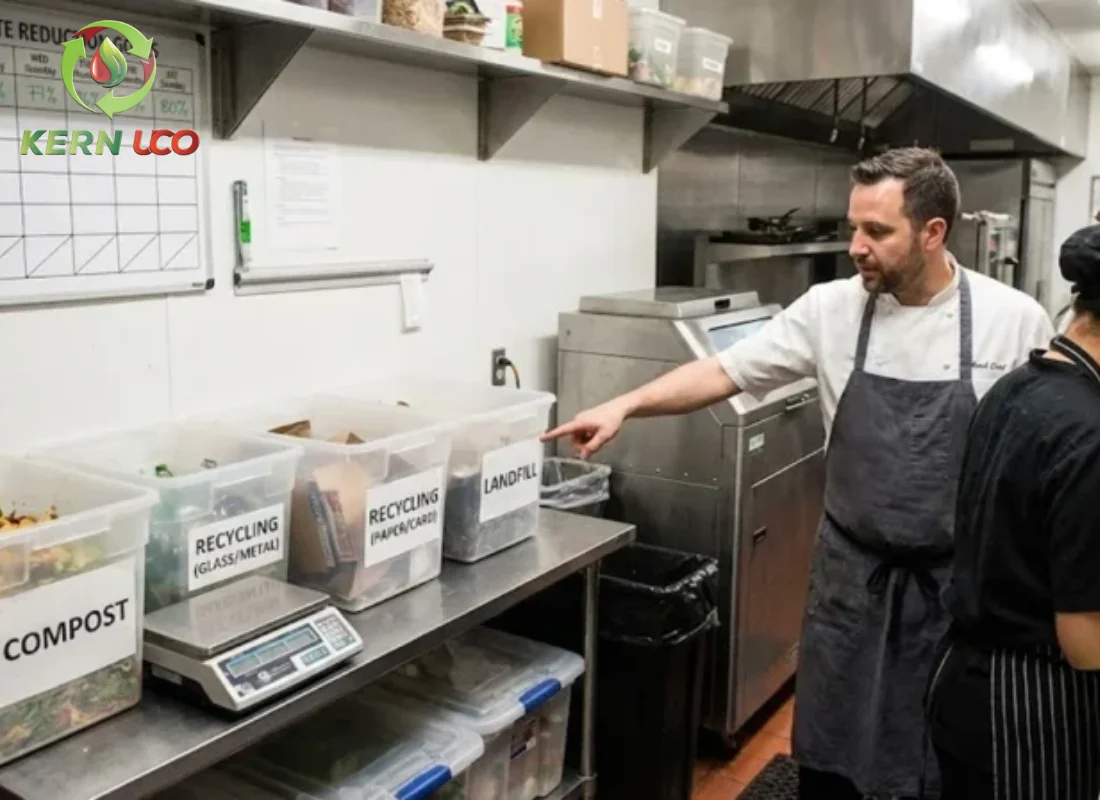
Recycling and material separation reduce hauling fees. Many waste haulers charge less for recyclable materials than for general waste, and some municipalities offer reduced rates for businesses that separate materials properly. A kitchen that's disciplined about separating cardboard, glass, and recyclables from general trash can see a real reduction in monthly hauling costs.
Used cooking oil recycling closes one of the biggest waste loops in the kitchen. This deserves its own deeper look, because it's one of the clearest examples of sustainability directly protecting the bottom line.
The Case Study Hiding in Every Kitchen: Used Cooking Oil
If you want to see the sustainability-equals-profitability argument play out in the clearest possible way, look at used cooking oil recycling. It touches nearly every category of business risk and cost at once, which makes it one of the best examples of why sustainable waste management pays for itself.
Restaurants that don't have a proper oil recycling system in place tend to face a predictable set of costs: emergency plumbing repairs from oil-clogged drains, regulatory fines for improper disposal, increased fire risk from improperly stored oil, and pest problems from discarded grease sitting around. None of these are hypothetical they're common, well-documented issues across the industry.
Restaurants that do have a proper system in place avoid nearly all of that risk, and in many cases, actually generate a small revenue stream, since used cooking oil has resale value once it's collected and refined into biodiesel or other products. This means the "sustainable" choice recycling the oil instead of discarding it improperly is also, straightforwardly, the cheaper and often more profitable choice.
It's rare to find such a clean example of sustainability and cost-efficiency being the exact same decision. Most sustainability initiatives require some kind of tradeoff analysis. Oil recycling barely does the case for it is almost entirely one-sided once you look at the actual numbers.
For a more detailed breakdown of how oil recycling fits into a restaurant's overall waste strategy, take a look at our full guide on <a href=" target="_blank" rel="noopener noreferrer">restaurant waste management</a>, which covers how oil, food waste, and packaging work together as one connected system rather than separate problems.
Energy Efficiency: The Quiet Bottom-Line Booster
Waste management tends to get the most attention, but energy efficiency deserves a place in this conversation too, since utility costs are a significant and often under-optimized expense for most restaurants.
Equipment maintenance matters more than people realize. A well-maintained fryer, refrigeration unit, or exhaust system runs more efficiently than a neglected one. Grease buildup in exhaust systems, for example, forces ventilation fans to work harder, increasing energy consumption unnecessarily. This is yet another way that proper grease and oil handling connects directly to lower operating costs.
LED lighting and programmable equipment reduce ongoing costs. These are relatively low-investment changes with a fast payback period, especially in kitchens that operate long hours.
Refrigeration efficiency protects both energy costs and food quality. Properly maintained refrigeration units use less energy and are less likely to fail, which also protects you from the much larger cost of spoiled inventory during a breakdown.
None of these changes require dramatic reinvention. They're the kind of steady, unglamorous maintenance work that quietly reduces monthly utility bills over time.
Water Conservation: Small Changes, Steady Savings
Water usage is another area where sustainability and cost savings overlap cleanly. Low-flow spray valves for dishwashing stations, fixing leaks promptly, and running dishwashers only at full capacity are all simple changes that reduce water and, often, the energy costs associated with heating that water. None of these require major capital investment, and most pay for themselves within the first year through reduced utility bills.
Building a Sustainability Strategy Around ROI, Not Just Optics
If you're building out a sustainability plan for your restaurant, the most effective approach is to prioritize based on measurable return, not just visibility. It's tempting to lead with the changes customers will notice compostable packaging, a visible recycling bin but the changes that actually move your bottom line are often the ones happening entirely behind the scenes.
A practical way to prioritize:
Start with food waste. It's usually the largest cost opportunity, and even modest improvements in portion control and inventory management produce noticeable savings.
Formalize your used cooking oil recycling system. This is one of the highest-certainty wins available low effort, low risk, and a near-guaranteed reduction in both cost and liability.
Audit your general waste hauling. Look at what's being thrown away that could be recycled or separated for lower disposal rates.
Address energy efficiency through maintenance. Prioritize equipment upkeep over new purchases where possible a well-maintained system is often nearly as efficient as a brand-new one.
Layer in customer-facing changes last. Once the operational fundamentals are solid, visible sustainability efforts (packaging, signage, sourcing) become a genuine value-add rather than a distraction from the real work.
This order matters. Restaurants that start with the visible, customer-facing changes and never get to the operational fundamentals often end up with sustainability efforts that look good but don't actually move the needle financially.
The Bigger Picture: Where Your Waste Actually Goes
Part of what makes sustainable waste management genuinely satisfying, beyond the financial case, is understanding that materials leaving your kitchen don't just disappear. Recycled cooking oil becomes biodiesel and other renewable products. Recycled cardboard and glass re-enter manufacturing supply chains. This is part of a much larger renewable resource economy, and organizations focused on sustainable commodity trading, such as <a href=" target="_blank" rel="noopener noreferrer">Start Green Commodities</a>, play a role in connecting recovered materials like used cooking oil to markets where they get turned back into usable products.
For restaurant owners, understanding this bigger picture adds real substance to sustainability efforts. It's not just about reducing a number on a waste hauling invoice it's about participating in a system that gets more value out of resources that would otherwise be discarded entirely. That's a genuinely compelling story to share with staff, and increasingly, with customers who care where their food (and the waste behind it) actually ends up.
Measuring Whether It's Actually Working
None of this matters if you're not tracking results. A sustainability strategy built around bottom-line impact needs to be measured the same way any other operational initiative would be.
Track food cost percentage over time and watch for improvement as waste reduction measures take hold. Monitor waste hauling invoices month over month to see if separation and volume reduction are translating into lower fees. Keep records of your oil recycling service, including any revenue generated, and compare it against your prior informal (or nonexistent) disposal costs. Watch utility bills for trends following equipment maintenance or efficiency upgrades.
This kind of tracking turns sustainability from a vague, feel-good initiative into a measurable operational program one you can defend with real numbers if anyone, from an investor to a franchise partner, ever asks whether it's actually worth it.
Final Thoughts
Restaurant sustainability practices earn their place in your operations plan not because they're trendy, but because the ones that matter most reducing food waste, recycling used cooking oil, tightening up general waste management, and maintaining equipment for energy efficiency are simply good business decisions wearing a sustainability label. The overlap between doing right by the environment and doing right by your P&L is much larger than most restaurant owners realize, especially once you move past symbolic gestures and into the operational fundamentals.
Start with the changes that touch your biggest cost categories, particularly food waste and used cooking oil, and build outward from there. The restaurants that treat sustainability as a genuine operational discipline, rather than a marketing checkbox, are the ones quietly building a leaner, more resilient, and more profitable business one waste stream at a time.